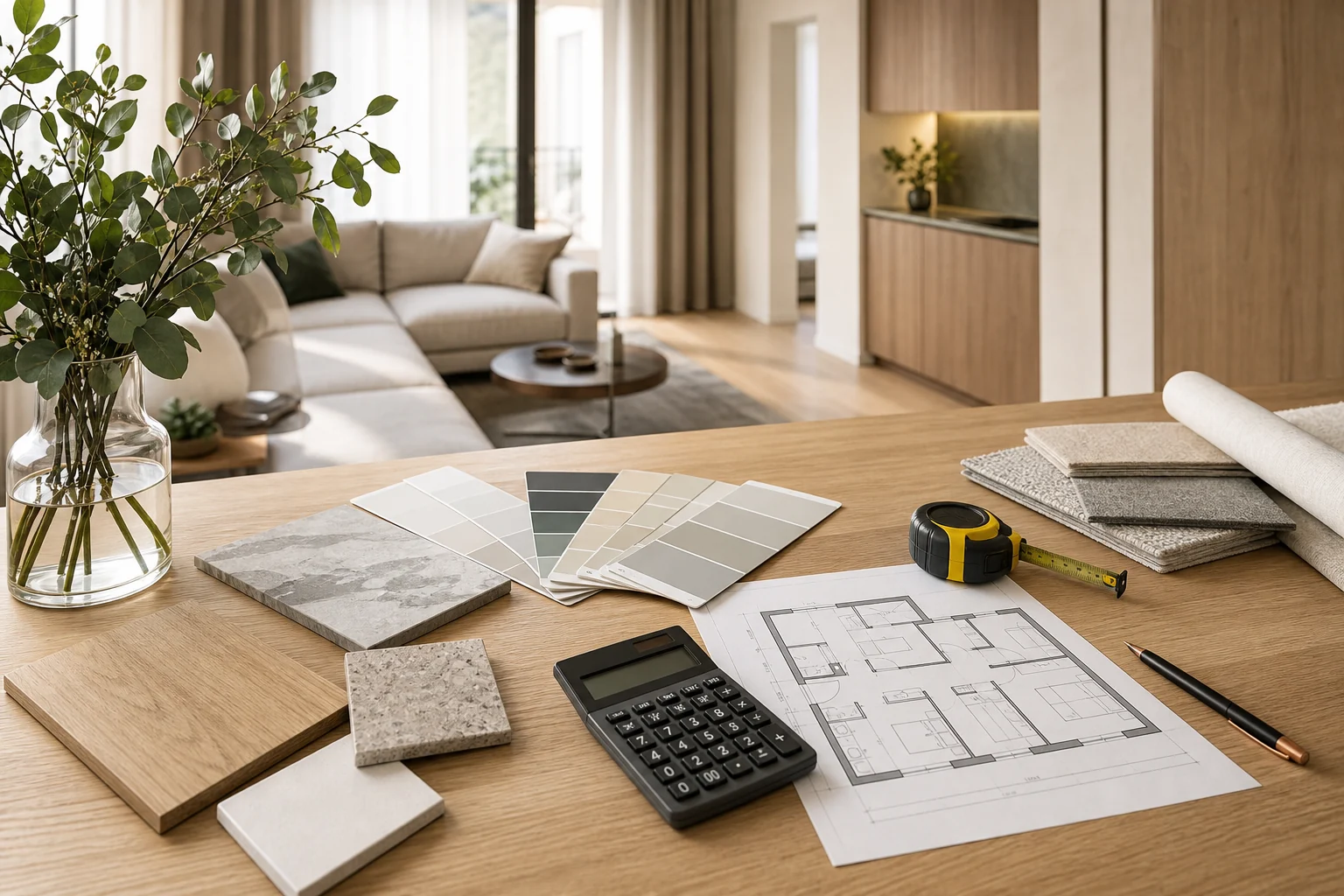
Key takeaway: an overrun rarely comes from one dramatic mistake. More often, it is built from small decisions made too late: unrecorded changes, omitted services, purchases made without comparison or no contingency for issues discovered after work begins.
A good budget does not pretend everything can be predicted. It shows what is confirmed, what is estimated and what needs a decision before ordering. It is easiest to create after the scope is organised in an interior project plan.
Split the budget into complete categories
A list called “materials and labour” is too short. In practice, a budget may include design and consultations, preparation works, services, finishes, joinery, loose furniture, lighting, appliances, delivery, carrying, installation, cleaning and costs of living outside the home temporarily.
Not every investment has every category, but each should be consciously marked as needed, not needed or to be confirmed. That way, an empty line in a spreadsheet is not mistaken for a zero cost.
Set a limit, priorities and contingency
Start with the maximum whole-investment amount, then identify the areas where you do not want to compromise: durable flooring, good light, an ergonomic kitchen or safe services, for example. Only then distribute the remaining amount among categories.
A contingency is not spare money for decorations. It is protection for uncertainty: the condition of existing services, material changes, extra work or delays. Its size depends on the property condition and certainty of scope; the more unknowns, the more important it is to separate it from the planned spend.
Watch the cost of changes during works
The most expensive decisions are not always the biggest. Moving one electrical point, changing a joinery dimension or switching tiles can trigger deliveries, additional labour and revisions. Before works begin, try to finalise the layout, services and key materials as far as reasonably possible.
A good interior project timeline does not remove flexibility. It reveals when a change is still inexpensive and when it starts affecting other decisions.
Compare total cost, not one product price
When choosing a material, check more than the unit price. Ask about required quantity with allowance, availability, delivery, installation, system components, lead time and returns. When comparing services, compare scope, availability and quality, not only the price of one stage.
This is especially important for joinery, lighting and kitchens: a cheaper item can require more expensive adaptation or fail under the way you use the home. Read Interior Design Costs in Poland for questions that make design proposals comparable.
A simple budget-control rhythm
- List every category and assign a limit.
- Record each decision as planned, ordered or paid.
- Keep confirmed costs separate from estimates.
- After every change, update its effect on the whole, not only one line item.
- Do not use contingency without consciously deciding what it replaces or what you give up.
A prepared brief helps a designer choose solutions that belong in the real budget. Before collecting quotations, use AI Project Compass and record the priorities the budget must protect.
| Category | Example items | Control question |
|---|---|---|
| Design | Concept, documentation, consultations, supervision | Which support is required? |
| Works | Demolition, services, preparation, installation | Is the contractor scope written down? |
| Finishes | Flooring, walls, bathroom, doors | Are accessories and installation included? |
| Furnishing | Kitchen, joinery, furniture, lighting, appliances | What needs to be ordered early? |
| Logistics and contingency | Delivery, carrying, storage, uncertainty | What happens if availability or property condition changes? |
Where should I start a renovation budget?
Start with the project scope and a maximum whole-investment amount. Then divide the spend into categories rather than beginning with individual products.
Do I need a contingency?
It is worth separating one, especially when renovating an existing property. Its level should reflect the number of uncertain elements.
Should I buy materials before the design is complete?
Usually not. First settle the layout, services, dimensions and material direction so you do not buy elements that later conflict with the whole project.
What most often causes budget overruns?
Late changes, non-comparable proposals, omitted services and purchases made without checking delivery and installation costs.
Can a designer help control the budget?
It depends on the scope. A designer may select solutions, prepare schedules and explain the impact of changes when that is agreed.
Is it worth tracking the budget in a spreadsheet?
Yes, if it records the status of each item and distinguishes planned, ordered and paid. The tool matters less than regular updates.
What should I do when a cost increases?
Check the effect on the whole investment and decide consciously: use contingency, change a priority or find an alternative with a similar function.
How does a brief help with budget planning?
It brings together scope, area, rooms, timing and priorities, so quotations and recommendations relate to the same investment.