Key takeaway: you do not need to know a style label to prepare well for a conversation with a designer. It is more useful to recognise recurring signals: how the space should work, how much light and decoration you enjoy, which materials appeal to you and what you definitely do not want.
One image may appeal because of its colour, another because of its light, and a third because of its layout. Defining style is therefore not about finding one label online. It is about building a conscious direction that a designer can translate into real decisions.
Style is the result of decisions, not the starting point
An interior can feel warm, ordered, soft, graphic, calm or expressive. Each of these words describes an experience, not only a trend. When you combine them with the function of the home, materials and light, you create a more useful brief than a style name on its own.
For example, minimalism may mean empty surfaces and a cool palette to one person, while to another it means soft forms, timber and generous concealed storage. Without clarification, a designer may understand the word differently from you.
Begin with life in the space
Before choosing colours, ask questions about your everyday rhythm. Do you need space for focus, entertaining, rest, cooking, home working or family life with children? Should the interior be easy to maintain, presentation-ready, resilient under heavy use or able to shift with different times of day?
A style that does not support daily life quickly loses its appeal. A pale sofa may look perfect in a photograph, but in a home with small children, texture, easy cleaning or a replaceable cover may matter more. This is not giving up on aesthetics. It is making them work intelligently.
Choose references that actually explain something
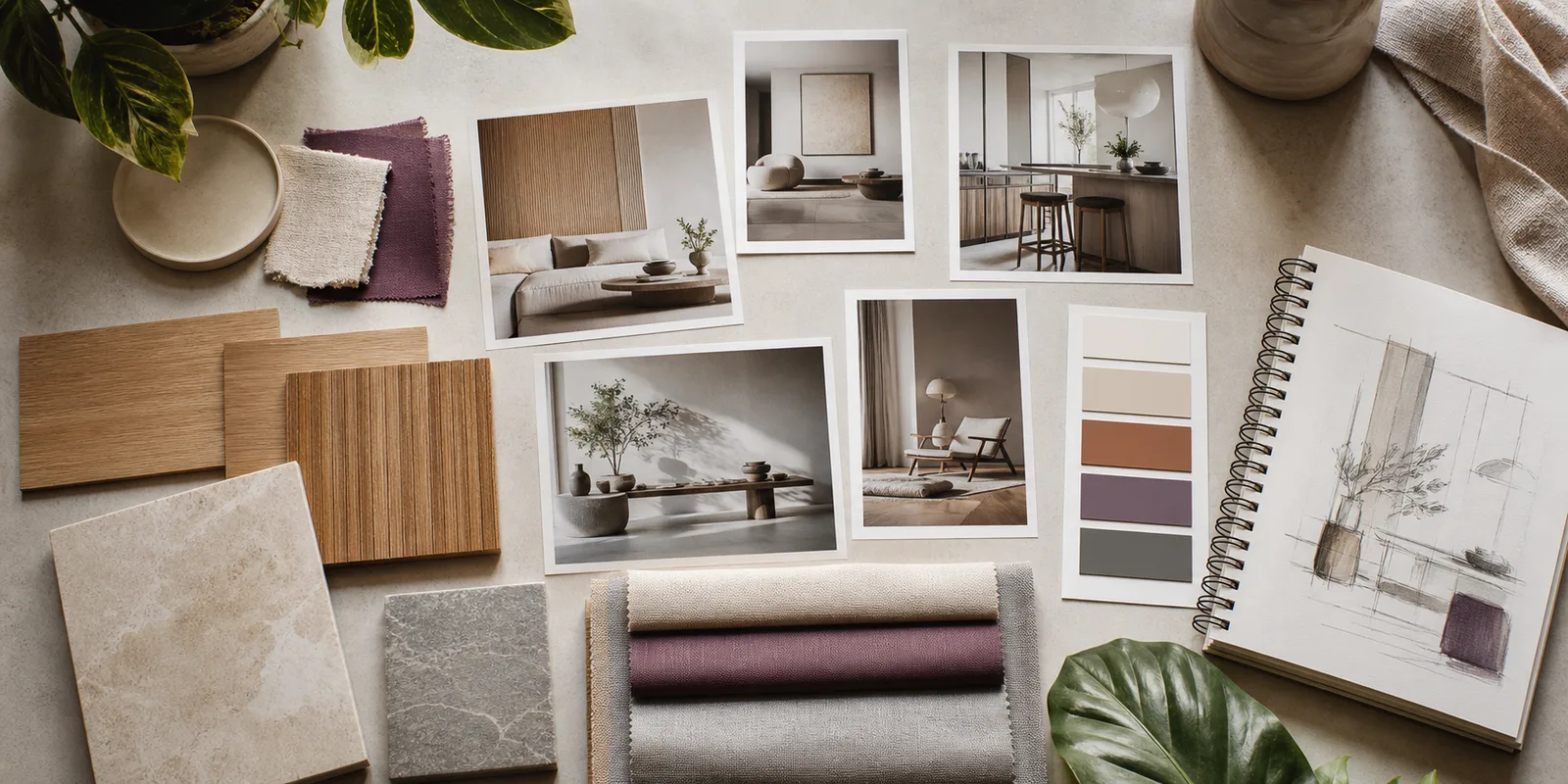
Prepare 10–15 references and organise them into groups: complete interiors, kitchens, bathrooms, details, light, materials and furniture. For each image, write what specifically attracts you. Rather than I like this living room, write: I like the soft side light, warm timber tone and absence of excessive decoration.
Add a few negative examples too. Explaining that you do not enjoy cold gloss, open shelving, dark floors or very high-contrast combinations is as useful to a designer as a list of favourite images.
Read the moodboard as a set of signals
Once the images are collected, look at what repeats without you planning it. Do natural materials or smooth surfaces dominate? Is the light diffused or directional? Do the furniture forms have soft curves or crisp edges? Are the rooms restrained or layered with detail?
These repetitions create the direction. A style name can help communication, but it should not close the conversation. Often the best description is: warm, calm minimalism with natural timber, soft fabrics and carefully concealed storage.
How to reconcile references that seem to conflict
Do not worry if some images are very calm and others more decorative. That is normal. Instead of trying to copy them all, separate their roles. One can inspire colour, another light, a third function and a fourth atmosphere.
It helps to establish three layers: a base, an accent and an avoidance. The base describes the dominant atmosphere, the accent adds personality and the boundary protects the project from random decisions. This allows different references to work together without turning the home into a collection of disconnected quotes.
Use AI as a conversation tool, not a verdict
AI Project Compass can analyse a group of images and identify recurring materials, colours and stylistic direction. It is a useful way to name an intuition, especially when it is difficult to describe in words. The result does not replace a designer or your own needs.
After the analysis, check whether the description genuinely fits your images and your lifestyle. Note what it captured accurately, what is missing and what you want to reject. That commentary is excellent material for a brief.
Prepare a style description for your brief
Finally, write a short description in a few sentences. Include the feeling, light, palette, materials, amount of decoration and functional requirements. Add 3–5 priorities and 3–5 things you do not want. It does not need to be literary. It needs to be clear to the person who will propose solutions.
When you combine that style description with area, scope, budget and timing, a professional in the Designer Directory can more easily assess whether their experience fits your project.
Interior style checklist
- How should a person feel in this space?
- Which materials, colours and type of light appear most often?
- How much decoration, open shelving and visible objects are you comfortable with?
- Which images show function and which show only mood?
- What matters more: durability, easy care, presentation or flexibility?
- Which three elements must remain, and what do you definitely want to avoid?
You do not need a perfect moodboard to begin an interior project. You need a sufficiently clear direction that can be developed and tested together in real conditions.
| Signal in an image | What it may mean | How to describe it in the brief |
|---|---|---|
| Soft, diffused light | A calmer atmosphere with less contrast | I want warm, layered lighting in the evening. |
| Natural timber and fabric | A need for warmth, texture and less gloss | I prefer natural materials and matte, tactile finishes. |
| Few items on display | Order and concealed storage | I need generous closed storage and calm worktops. |
| Rounded forms | Softer proportions and a gentler character | I want to avoid overly sharp, technical furniture lines. |
| A bold detail | Room for personality without visual dominance | I want one stronger accent, supported by a calm base. |
Do I need to know the name of an interior style?
No. It is more useful to describe the atmosphere, function, materials, colours and things you do not want. A style name can be a shortcut, not the whole answer.
How many images should a moodboard contain?
Usually 10–15 considered references, plus a few examples of what you want to avoid, are enough. Add a short comment to each image.
What if I like several different styles?
Separate what matters in each image: function, colour, light, material or detail. Then choose a dominant base, one or two accents and a list of things you do not want to combine.
Will AI identify my style correctly?
AI can identify patterns in images, such as materials, colours and stylistic direction. Treat the result as a suggestion to review, especially when your references combine several influences.
Should the style be the same throughout the whole home?
It does not need to be identical, but it should have a shared logic. You can vary functions and moods between rooms while repeating materials, a palette or an approach to light.
How do I describe style if I do not know design vocabulary?
Use simple words about feeling and daily life: light or dark, calm or expressive, soft or graphic, easy to maintain, lots of storage, little decoration. A designer can ask for the details.
Is it useful to show references I do not like?
Yes. Negative references quickly reveal boundaries: gloss, colour, amount of decoration, flooring or layout that you want to avoid. Just explain what exactly does not work for you.
How can I connect my style description with choosing a designer?
Attach the references and description to your brief, then compare portfolios, specialisms and ways of working in the Designer Directory. Style is one criterion alongside scope, location, budget and availability.